Showing posts with label manga. Show all posts

Sunday, 17 April 2016

Manga WANGAN MIDNIGHT

File:Midnightvol1.jpeg

The story gets its roots from the street racing that occurs on Tokyo's Shuto Expressway Bayshore Route. 'Wangan' (literally bayshore in Japanese) is the endonym of this longest, straightest road in the entire country. There is also road traffic to contend with, including a fair number of heavy trucks. Because of this, the action is inherently hazardous, and wrecks are common. Blown engines are also a frequent hazard, especially with the extremely high power engines.
One day, Akio Asakura, a high school student in his last year of study, is driving his Nissan Fairlady Z (Z31) on the Shuto Expressway when he challenges Tatsuya Shima, a doctor, in his black Ruf CTR, dubbed the "BlackBird". With his friend in the passenger seat and two girls in the back, Akio attempts to win, but is defeated. Determined to drive a faster car, he goes to the junkyard because his mechanic friend tells him he saw the scrapped body of an S30 Z with good parts on it. When he sees the scrapped body of a midnight blue Fairlady Z (S30) in the junkyard, he remembers seeing this car a few years ago with a nice girl in the passenger seat. Intrigued as to why such a classic Japanese performance vehicle is about to be junked, he convinces the junkyard owner to sell it to him. The junkyard owner was told by the previous owner to scrap the car because it is cursed. He soon finds that the car is unnaturally fast due to a tuned L28 engine, bored and stroked to 3.1 L, fitted with triple carburettors and fitted with twin turbos. He also finds that one of the car's previous owners shares his first and last name, and had been killed in a horrible crash on the Wangan few years ago. Every person who takes possession of the Z ends up spinning out of control and crashing, as if the car is rebelling against its driver. This gives the blue Z the nickname "The Devil Z".
The manga follows Akio's various encounters with people on the Wangan, and his maniacal attempts to control the car, though the central plot revolves around his constant battle with the BlackBird for Wangan superiority.
The new story arc, Wangan Midnight C1 Runner, features the new adventures of the new main character, Shinji Ogishima (which debuted in the last chapters of the original story), and his friend, Nobu Setoguchi, both are part of "GT Cars" project which is in dispute and conflict, and must settle these problems by driving Mazda RX-7s around Shuto Expressway, and meeting with Tatsuya Shima.
Character
  • Akio Asakura
An ambitious racer who started when he was very young, Akio was in his final year of high school as the story began. He was driving his redFairlady Z (Z31) until, after a humiliating loss to Tatsuya Shima, he discovered the "Devil Z", a Nissan Fairlady Z (S30) which is supernaturally fast and extremely hard to drive. Akio is regarded as a legend on the Wangan, although he is a humble young man. Still, despite his gentle demeanor, he is so serious about racing that he skips school to the point of repeating a grade to drive the Devil Z. Akio has trouble forming intimate relationships, although he has made some slight inroads with Reina Akikawa. His day job is a waiter for a night club, but was later fired for showing up late too often due to late night racing. He is regularly exposed to the active social scene at the heart of Tokyo. He was already an accomplished racer with his old car, but behind the wheel of the Devil Z, Akio is nearly invincible. He is very adaptable and can learn to drive virtually anything.
Voiced by: Shun Oguri
  • Reina Akikawa
Reina is a very attractive model who also co-hosts a driving television show named "Drive Go Go!" where the latest automotive trends are discussed. She finds Akio on the Wangan and becomes obsessed with him and the Devil Z, driving her to tune her car and even steal the Devil Z one night (but is stopped by Akio). After getting her Nissan Skyline GT-R (R32) tuned and modified, she discovers a previously unknown aptitude for street racing, something that does not sit very well with her manager. She is very sociable, and has lots of acquaintances, but has no real boyfriend. While she is an idol, she is quite modestly dressed. Like most of the women in the series, Reina is very sensitive and bursts into tears easily in some volumes and one episode of the anime, although she calms down considerably in later volumes. In the manga, her hair is curly, but in later volumes of the manga (and the anime), she only has straight hair.
Voiced by: Reiko Suhou
  • Tatsuya Shima
He is the main rival of Akio Asakura, as Akio is the only one who regularly gives him a challenge. He drives a Porsche (in fact, it is a RUF CTR "YellowBird", renamed "BlackBird" because of its color) in the anime and manga, and a Nissan 350Z in the English version of the Maximum Tune games up until 3DX+ and a fictional Gemballa 3.8 RS in the japanese version. The car has 470 hp (350 kW) stock. Tatsuya becomes annoyed with Akio becoming faster all the time so he hires Jun Kitami, the man who built the Devil Z, to tune the Porsche. Kitami tunes the suspension and adds a second turbo and boosts the car to 700 hp (520 kW) and beyond to try and keep up with the Devil Z. He is an extraordinarily skilled driver and has only been in one wreck during the course of the anime, when he swerved to avoid two drunk men on the road, only to swerve again to avoid a taxi and end up hitting a pole. He knows the limits of his vehicle and will never risk disaster by pushing it beyond its safe limits. This cost him a couple of battles, but he always learns from his failures and comes back even tougher. He is a very skilled surgeon and uses his large salary to fund his Porsche.
Voiced by: Shin-ichiro Miki

Manga

  • Japanese Release - 42 Volumes (1990 - 2008)
  • C1 Runner Japanese Release - 12 Volumes (2008–2012)
  • Taiwanese release - 38 Volumes
  • Chuang Yi release - 42 Volumes
  • C1 Runner Chuang Yi release - 11 volumes (ongoing)
The first Wangan Midnight volume was released in Japan in 1990, and has never been translated into any other languages during its publication run, and the final volume was published in mid-2008. However, Taiwan-based Sharp Point Press has obtained license for translating the manga into Chinese, but this was stopped after volume 38 due to an expired license. There have been no announcements as to a new distributor in Taiwan for continuing or restarting the manga.
The C1 Runner arc started in 2008 shortly after the main story and ended in July 2012, thus ending the entire Wangan Midnight manga series.
In Singapore, the main Wangan Midnight manga, along with C1 Runner volumes, has been translated by Chuang Yi into English for Singaporean readers. However, despite being translated into English, the manga series was never popular as its rival, Initial D (which was translated into Chinese by the same company). Even the Wangan Midnight Maximum Tune series and thePS3 game of the same name did not help improving the sales of the manga. Despite this, the C1 Runner arc is currently translated into English as well.

Movies

The series was adapted into a series of direct-to-video movies in 1994, 1997 and again in 2000. They accurately depict the manga, with the exception of Akio being in his thirties. Many Japanese viewers hold the films in high regard for their realistic portrayal of the racing with the cars having the speed they have in the manga.
  • Wangan Midnight (湾岸MidNight), 1991
  • Wangan Midnight II (湾岸ミッドナイトII), 1993
  • Wangan Midnight III (湾岸ミッドナイトIII), 1993
  • Wangan Midnight 4 (湾岸ミッドナイト4), 1993
  • Wangan Midnight Special Director's Cut Complete Edition (湾岸ミッドナイトスペシャル ディレクターズカット完全版), 1994
  • Wangan Midnight Final: GT-R Legend - Act 1 (湾岸ミッドナイト FINAL ~GT-R伝説 ACT1~), 1994
  • Wangan Midnight Final: GT-R Legend - Act 2 (湾岸ミッドナイト FINAL ~GT-R伝説 ACT2~), 1994
  • Devil GT-R Full Tuning (魔王GT-R チューニングのすべて), 1994
  • Showdown! Devil GT-R (対決!魔王GT-R), 1994
  • Wangan Midnight S30 vs. Gold GT-R - Part I (新湾岸ミッドナイト S30vsゴールドGT-R Part I), 1998
  • Wangan Midnight S30 vs. Gold GT-R - Part II (新湾岸ミッドナイト S30vsゴールドGT-R Part II), 1998
  • Wangan Midnight Return (湾岸ミッドナイト リターン), 2001
  • Wangan Midnight The Movie (湾岸MidNight Movie), 2009

Video games

The series has been adapted into a series of video games, developed by Namco. The first game, Wangan Midnight was released on February 2, 2001. On December 20, 2001, Wangan Midnight R was released. A PS2 version of Wangan Midnight was released later on March 21, 2002. It was basically a home port of Wangan Midnight R. A complete re-imagining of the game series, Wangan Midnight Maximum Tune, was released in July 2003 to arcades only, followed by another sequel, Wangan Midnight Maximum Tune 2, on April 2005. The third installamentWangan Midnight Maximum Tune 3 was released on July 18, 2007 in the arcade, with a sequel to the original game following on the PlayStation 3 and PlayStation Portable platforms. The updated version, Wangan Midnight Maximum Tune 3 DX, a fourth installment was released on December 16, 2008. The PS3 and PSP games were re-released in 2008 under the "Genki The Best" label. An RPG which was a sequel to the PS3 and PSP games, titled Wangan Midnight: C1 Runner (based on the manga of the same name), was also released by Genki. Wangan Midnight Maximum Tune 3 DX PLUS, the fifth installment was released in March 4, 2010 (in Japan) and May 2010 (in Indonesia). The sixth installament, Wangan Midnight Maximum Tune 4, the sixth installment was released on December 15, 2011 (early in Japan), on 15 December 2012 (in Australia) and 27 November 2013 (in Indonesia) and run by an upgraded version of the System N2, called System ES1A2. The seventh installment, Wangan Midnight Maximum Tune 5, was released on March 12, 2014 (early in Japan), on 22 October 2015 (in Australia) and 15 December 2014 (in Indonesia). Wangan Midnight Maximum Tune 5 is also distributed as an upgrade kit for Wangan Midnight Maximum Tune 4 arcade machines. Wangan Midnight Maximum Tune 5 DX, the eighth installment was released early in Japan on 15 December 2015 also International and Indonesian version were released lately in 2016. The majority of Wangan Midnight Maximum Tune racing games feature trance music soundtracks composed and produced by Yuzo Koshiro. The main objective in the Wangan Midnight and Wangan Midnight R and Maximum Tune is, as the main player, beat all the characters and cars including the Devil Z and Blackbird driven by Akio and Shima from the manga and anime. In the Maximum Tune series, players can also tune their car or modify its appearance upon victory, depending on the game mode being selected.
In Wangan Midnight Maximum Tune 5 has a Story Mode is where the initial characters from the comic show as your rivals in the story. Your mission in story mode is to race with these characters and beat them. In addition, one of the objectives of this game is “Tuning (Step-Up).” Step up your car is an objective of Story Mode.
In story Mode, first, choose your rival’s level, then select an opponent out of the rivals that are of the selected level. You can openly change the levels and rivals within the limited time.
Story Mode proceeds as follows:
Episodes 1-10: The Return of Devil the Z
This is taken from the story written in Wangan Midnight comics, volumes 1 to 3.
This story will tell about “Akio”, “Reina”, “Blackbird”, and “Ishida” in each levels of characters.
Episodes 11-15: Perfect GT-R
This is taken from the story written in Wangan Midnight comics, volumes 3 to 5.
You will race on an ultra high-speed Wangan line battle with Hiramoto and Harada.
Episodes 16-20: The Akasaka Straight
This is taken from the story written in Wangan Midnight comics, volumes 5 to 8.
This part will focuses in a battle with ex-metropolitan highway racer, “Masaki.”
Episodes 21-30: Monster Machine
This is taken from the story written in Wangan Midnight comics, volumes 8 to 13.
In this part you will meet the wild driving and wild stories of the tuners who are mad about “Keiichiro Aizawa’s Supra.”
Episodes 31-40: R200 Club
This is taken from the story written in Wangan Midnight comics, volumes 13 to 16.
In this part you will battle with members of the “R200 Club” and observer honor “Kuroki’s” passion for the 33R.
Episodes 41-50: Hanshin Circular Line
This is taken from the story written in Wangan Midnight comics, volumes 16 to 20.
In this part is a race against Eiji Kamiya, a racer from Osaka who drives a Lancer Evolution.
Episodes 51-60: The Legendary FC
This is taken from the story written in Wangan Midnight comics, volumes 20 to 24.
In this part you will race with “Kijima” who will show you his passion with the RX-7 FC3S.
On release, Famitsu magazine scored the first PlayStation 2 version of the game a 30 out of 40.
  • February 2, 2001: Wangan Midnight (Arcade (System 246))
  • December 20, 2001: Wangan Midnight R (Arcade (System 246))
  • March 21, 2002: Wangan Midnight (PlayStation 2)
  • July 6, 2004: Wangan Midnight Maximum Tune (Arcade (Chihiro))
  • April 21, 2005: Wangan Midnight Maximum Tune 2 (Arcade (Chihiro))
  • July 5, 2007: Wangan Midnight (PlayStation 3)
  • July 18, 2007: Wangan Midnight Maximum Tune 3 (Arcade (System N2))
  • September 2, 2007: Wangan Midnight Portable (PlayStation Portable)
  • December 16, 2008: Wangan Midnight Maximum Tune 3 DX (Arcade (System N2))
  • March 4, 2010: Wangan Midnight Maximum Tune 3 DX PLUS (Arcade (System N2))
  • 2011: Wangan Midnight: C1 Runner (Mobile phone)
  • December 15, 2011: Wangan Midnight Maximum Tune 4 (Arcade (SystemES1))
  • December 15, 2013: Wangan Midnight Maximum Tune 5 (Arcade (SystemES3))
  • December 15, 2015: Wangan Midnight Maximum Tune 5DX (Arcade (SystemES3))

Anime

At the 2007 Tokyo Anime Fair, OB Planning (Initial D) announced the production of an animated series based on the manga. Aired on a pay-per-view channel of Animax in June 2007, the series was co-produced by OB Planning, A.C.G.T., and Pastel under the direction of Tsuneo Tominaga and consists of twenty-six episodes. The series was released on DVD with the thirteenth volume reaching 29th on the Oricon sales chart for Japanese animation DVDs in November 2008. The Japanese opening theme for the series is Lights and Anymore by TRF, the opening features clips of Akio's Devil Z also featuring the 3 main characters and also features Akio's Devil Z racing against Shima's Blackbird. The closing theme is Talkin' bout good days by Mother Ninja. The animation is similar to that of Initial D Fourth Stage and Fifth Stage.

Wangan Midnight: The Movie (2009)

On September 12, 2009, Jolly Roger and Geneon Universal Entertainment released a live-action adaptation of the manga. Wangan Midnight: The Movie is directed by the Atsushi Muroga, with the screenplay written by Yasutoshi Murakawa. The film stars Yuichi Nakamura as Akio Asakura, Ryoko Kobayashi as Eriko Asakura, Kazuki Kato as Tatsuya Shima, Rio Matsumoto as Reina Akikawa, and Masaki Sata as Kou-chan.[8] The film was shot in Wangan as a stand-in for the expressway racing scenes. Like the previous anime television series and video features, Wangan Midnight: The Movie will center on Akio Asakura's "Devil Z" and the rivalry with "Black Bird".
It appears that a sequel may be planned, as after the ending credits in a bonus scene, Shima is seen to be leaving work when he hears the sound of a Z we don't know if its Akio's car or not, followed by a fade out message saying 'Z will be back', which is a reformed "Devil Z" (Nissan Falrlady Z/ 240Z/280Z/370Z).

Sunday, 10 April 2016

Initial D

Initial D
Initial D (Japanese頭文字D(イニシャル・ディー) HepburnInisharu Dī?) is a Japanese sports manga series written and illustrated by Shuichi Shigeno. It was serialized in Young Magazine from 1995 to 2013, with the chapters collected into 48 tankōbon volumes by Kodansha. The story focuses on the world of illegal Japanese street racing, where all the action is concentrated in the mountain passes and rarely in cities or urban areas, and with the drift racing style emphasized in particular. Professional race car driver and pioneer of drifting Keiichi Tsuchiya helped with editorial supervision. The story is centered on the prefecture of Gunma, more specifically on several mountains in the Kantō region and in their surrounding cities and towns. Although some of the names of the locations the characters race in have been fictionalized, all of the locations in the series are based on actual locations in Japan.
Initial D has been adapted into several television anime and original video animations series by OB Studio CometStudio Gallop, Pastel, A.C.G.Tand SynergySP. A live action film by Avex and Media Asia was released in 2005 and its sequel, Initial D 2, will be released in 2016. Both the manga and anime series were initially licensed for English-language distribution in North America by Tokyopop (2002–2009),[1] however, the anime license has since been picked up by Funimation Entertainment, while the manga is no longer available in English

The protagonist, Takumi Fujiwara, is a gas station attendant working with his friend Itsuki to buy a car, which they plan to drift on the twisting roads surrounding nearby Mount Akina. Unbeknownst to his colleagues, Takumi moonlights as a tofu delivery driver for his father's store before sunrise each morning, passively building an impressive amount of skill behind the wheel of the family car, an aging Toyota Sprinter Trueno.
Shortly after the story begins, the RedSuns, an amateur racing team from Akagi Prefecture, challenge the local Speedstars team to a set of races on Mount Akina. Dispirited after watching the RedSuns' superior performance during a practice run, the Speedstars expect to lose. Later that night, the RedSuns' #2 driver, heading home after the last practice run, is defeated soundly by a mysterious Sprinter Trueno, despite driving a much more powerful car. An investigation into the identity of the driver leads to Bunta Fujiwara, Takumi's father. The Speedstars beg Bunta to help them defeat the RedSuns, and he initially refuses, later relenting to "maybe" show up at the race. At the same time, Takumi asks Bunta if he can borrow the car for a day to take a trip to the beach with a potential girlfriend, and Bunta seizes the moment by granting permission (plus a full tank of fuel) on the condition that Takumi defeats the RedSuns driver.
On the night of the race, the Trueno does not show up, and the Speedstars enlist a backup driver for the first run. At the last moment before the race starts, the Trueno arrives. Takumi steps out of the car to the bewilderment of the Speedstars, who were expecting Bunta. He easily defeats the RedSuns driver by utilizing a dangerous technique on the mountain road's hairpin corners.
The RedSuns' embarrassing defeat sets up the plot for the rest of the series: drivers from neighboring prefectures come to challenge Takumi and the "Legendary Eight-Six of Akina" and thus prove themselves as racers. Eventually, the plot moves away from Mount Akina as Takumi becomes bored with racing solely on that road. He joins an experimental racing team formed by the disbanded RedSuns and challenges more difficult opponents on their home courses in the pursuit of his dream to be "the fastest driver out there".
  • Takumi Fujiwara (藤原 拓海 Fujiwara Takumi?, "Tak")
The main character of the series, Takumi develops his racing skills to be one of the fastest drivers in Kanto while driving an old Toyota Sprinter Trueno AE86. This is due to Takumi's job delivering tofu to Lake Akina every morning for 5 years (since 7th grade). Although Takumi believes this to be just a job, he had actually been manipulated subtly by his father into developing driving skills, without being fully aware of Bunta's intent.
  • Bunta Fujiwara (藤原 文太 Fujiwara Bunta?)
Bunta is the owner of the Fujiwara Tofu Shop and is the father of Takumi. He used to be the No.1 downhill racer in Mt. Akina years ago, but now guides Takumi's racing development. He is the original driver of the mysterious "Ghost of Akina" AE86 Sprinter Trueno that holds the record of the fastest downhill time at Akina. Later in the series, as Takumi used the Trueno more than Bunta, he buys a Subaru Impreza WRX, which Takumi alternates between the Impreza and his Eight-Six for deliveries.
  • Ryosuke Takahashi (高橋 涼介 Takahashi Ryōsuke?, "Ry")
Ryosuke is one of the most skilled drivers in the series as RedSuns/Project D's leader and older brother to Keisuke. He drives a Mazda Savanna RX-7 FC3S. Ryosuke is a very cerebral driver as he pores over technical data and is able to tell what kind of modifications have been made to a car just by hearing it, and what a driver is capable of just by watching the car drift. He is also referred to as "Akagi's White Comet" (赤城の白い彗星 Akagi no Shiroi Suisei?) in reference to his early racing days.
  • Keisuke Takahashi (高橋 啓介 Takahashi Keisuke?, "K.T.")
Keisuke is the number two driver for the RedSuns and the hillclimb ace for Project D. Keisuke drives a Mazda RX-7 FD3S, and is a skilled driver second only to his brother. Keisuke is a rather hot-headed and does not like losing. He isn't analytical like his older brother, but his ability to think less while he is driving, and to do only what he feels amazes Ryosuke. Because of his initial encounters with Takumi, he is Takumi's main rival.

Manga

  • Initial D Manga Japanese Release — 48 Volumes (1995–2013, Vol. 48 released in November 2013)
  • Initial D Manga Tokyopop Release — 33 Volumes (2002–2009, expired license)
The first Initial D volume was released in Japan on November 6, 1995 and concluded on July 29, 2013.[2] The manga has been translated officially into Chinese, French and English over its publication run. As of 2013, 48 volumes have been published.
The manga and anime were originally licensed for English releases in North America by Tokyopop. The company changed the names of the characters in the anime edition, and subsequently changed them in the manga to match. These name changes were to reflect the name changes that Sega implemented into the western releases of the Initial D A Stage video games {see below} due to name length limits. Tokyopop also cut out a character's enjo kōsai relationship with another and edited sex scenes, appearing in volumes 1 and 9 in the original manga. In addition, "street slang" was interlaced in translations (a drift was described as "slammin'", for example).
The manga also had some translation errors. One example was the technical term "Wastegate" (which is a mechanism used to regulate the boost pressure generated by a turbocharger) that was translated as "West Gate". Another was an inaccurate explanation of how an engine's displacement is calculated (the explanation given is how a ship's displacement is calculated, which is totally different). Many of the explanations ofautomotive design and function, as well as the specification sheets of the various cars, were incorrect.
In August 2009, Kodansha announced that they would not be renewing their licensing agreements with Tokyopop, citing "tense relations" between the two companies. This meant that Tokyopop could no longer release new volumes of Kodansha manga properties, nor re-release Kodansha titles that were already printed. Tokyopop ceased the release of Initial D after volume 33, which was released on December 30, 2008. Volume 34 had a scheduled street date of April 7, 2009, but never released. There have been no announcements as to a new distributor in North America for continuing or restarting the manga.

Avex has released the anime in several parts called Stages. One noticeable feature is that it uses Eurobeat music as background music in race scenes.
  • Initial D (referred to retroactively by fans as "First Stage") — 26 episodes (1998)
  • Initial D Second Stage — 13 episodes (1999)
  • Initial D Extra Stage — 2-episode OVA side-story focusing on Impact Blue (2000)
  • Initial D Third Stage — a 114-minute movie (2001)
  • Initial D Fourth Stage — 24 episodes (2004–2006)
  • Initial D Extra Stage 2 — a 50-minute OVA side-story focusing on Mako and Iketani (2008)
  • Initial D Fifth Stage — 14 episodes (2012–2013)[5]
  • Initial D: Final Stage — 4 episodes (TV), compilation movie (DVD/Blu-ray) (2014)
  • New Initial D the Movie - Legend 1: Awakening — feature movie (2014)
  • New Initial D the Movie - Legend 2: Racer — feature movie (2015)
  • New Initial D the Movie - Legend 3: Dream — feature movie (2016)
The Battle Stages are Musical Films serving as a compilation of the racing action scenes in the preceding series reanimated and remastered with more advanced CGI and stripped of all but minimal character dialog.
  • Initial D Battle Stage — a 50-minute movie (2002)
  • Initial D Battle Stage 2 — a 1-hour movie (2007)
In 1998, Initial D was adapted into an animated television series produced by OB Planning and Prime Direction. The first episode premièred onFuji TV on April 8, 1998. The initial series ran for 26 weekly episodes with the finale airing on December 5, 1998.
The second series, named "Second Stage", aired from October 14, 1999 to January 20, 2000 with a one-week break over the New Year period. This was followed by animated feature film in 2001 and an OVA documenting all battles from the previous three stages, with the battles from First Stage being re-animated.
Initial D: Third Stage was a feature film covering the story arcs between the second and fourth stage, released in Japan on January 13, 2001.
In 2004, Initial D: Fourth Stage aired on SkyPerfecTV's pay-per-view service, airing two episodes back-to-back every two months. 24 episodes were made until the final episodes were aired in February 2006.
Following Second Stage in 2000, Initial D: Extra Stage was aired as a spinoff to the original series. This story focused on the all-female Impact Blue team of Usui Pass and their point of view of the recent events of Second Stage and the upcoming Third Stage movie. This was followed byExtra Stage 2 in 2008, which look at the relationship between Impact Blue's Mako Sato and Iketani of the SpeedStars (following on from the original side-story in the manga).
Following 8 years after the release of "Fourth Stage" in 2004, Animax airs "Initial D: Fifth Stage". Animax has aired the series on a pay-per-viewbasis on SKY PerfecTV!'s Perfect Choice Premier 1 channel. The first two episodes aired on November 9, 2012. The rest of the episodes were broadcast two per month till May 10, 2013.
In 2014, "Initial D: Final Stage" became the latest installment in the anime series. Animax has aired its first two episodes on a pay-per-view basis on its own brand new ANIMAX PLUS channel, on May 16, 2014, on its new subscription VOD (Video On Demand) service, which allows subscribers to watch all the latest anime series. Initial D Final Stage will start right after where Fifth Stage left off. There are a total of four episodes that makes up this mini stage.[7] The final two episodes were broadcast on June 22, 2014.
Since the anime's original run, Japanese musical group m.o.v.e has performed all of the opening and some ending themes of the series. This followed on from the success of one of their first hits, "Around the World", which was used as the first opening of First Stage. Their latest single to be used in the series is called "Outsoar The Rainbow" and it is used as Final Stage's opening.They had another recent unreleased song, "Days". It was played on the finale of "Final Stage".
Like in the manga, Tokyopop change elements of the anime to suit Western audiences. As well as changing the names and used western slang, the company also changed the anime's music from the series' staple eurobeat tracks to originally developed tracks of rap and hip-hop via Stu Levy (DJ Milky), the Tokyopop CEO and an in-house musician.
In 2006, Funimation Entertainment announced that it would be distributing the DVDs of the anime (since Tokyopop's original distributor went bankrupt). This new distribution was marked by slightly revised packaging and two box sets corresponding to the licensed seasons Tokyopop had dubbed, although the DVDs themselves were exactly the same as the original Tokyopop release.
Tokyopop had completed an English dubbed version of Third Stage, and reportedly screened it at the Big Apple Anime Fest on August 29, 2003.They briefly mentioned that their version of Third Stage would retain the original Japanese soundtrack, in contrast to their treatment of the anime series. This version of the film was never released on DVD, nor was it ever mentioned by Tokyopop past the original announcement.
At the New York Anime Festival 2009, Funimation Entertainment announced that it would be re-releasing and re-dubbing Initial D: First Stage, Second Stage, Extra Stage, Third Stage, and Fourth Stage. Their release included a brand new English dub and retained the original music from the Japanese in an uncut format. Funimation released the series out of order, with the Third and Fourth Stages releasing before the First and Second Stages.[11] Funimation has not specified whether or not they will dub and release Extra Stage 2 (the first Extra Stage was included in the Second Stage box set) or either of the Battle Stages, nor have they made a decision about 5th Stage and Final Stage.
In July 2013 it was announced that another feature film titled New Initial D the Movie and a last anime series, Initial D Final Stage, will be produced.The movie is a retelling of the early Stages with a wholly new voice cast and will be separated into three parts, with the first part released on August 23, 2014.
Numerous arcade and other platforms video games have been released (note: The U.S. versions of the arcade titles are called simply "Initial D"). In the loading section after you pick the rival, you could see pictures from the Initial D manga. In Ver. 3, it basically has a picture of Natsuki Mogi in a bikini, this is cut in the U.S. version.
A live-action movie based on Initial D was released on June 23, 2005 in Asia. The movie was jointly produced by Japan's Avex Inc. and Hong Kong's Media Asia Group. It was directed byAndrew Lau and Alan Mak, whose credits include the 2002 Hong Kong blockbuster Infernal Affairs. The adaptation featured Taiwanese singer Jay Chou as Takumi Fujiwara and Hong Kong stars Edison Chen as Ryosuke Takahashi and Shawn Yue as Takeshi Nakazato. Despite many changes to the original story, the movie was met with critical acclaim and was nominated for multiple awards, including Best Picture, at the Hong Kong Film Awards and Golden Horse Awards, winning many of them.
A sequel has been in discussion since the following year after the movie has debuted. However, a concrete conclusion could not be reached due to several obstacles which includes the storyline, filming locations, casts, and safety reasons. As of March 2015, director and producer, Andrew Lau, has once again reconfirmed in an exclusive interview that a sequel will surely follow but is tight-lipped on the release date. Jay Chou and Edison Chen will reprise their roles in the sequel.


Legend....The King of Drift Car....

LEGEND...

The AE86 generation of the Toyota Corolla Levin and Toyota Sprinter Trueno is a small, lightweight coupe or hatchback introduced by Toyota in 1983 as part of the fifth generation Toyota Corolla lineup. For the purpose of brevity, the insider-chassis code of "AE86" depicts the 1600 cc RWD model from the range.


While other fifth-generation Corollas shifted to the FF (front-engine, front-wheel-drive) layout, the Corolla Levin AE86 retained the FR (front-engine, rear-wheel-drive) configuration, and its responsive driving performance won it the support of FR enthusiasts everywhere. The engine was upgraded from the 2T-GEU to the more powerful 4A-GEU, and high-grade models came equipped with electric windows and power-assisted steering. As the Corolla Levin also moved to the FF layout with the unveiling of the sixth-generation Corolla, the AE86 model became the last Levin with the FR configuration, and it is affectionately remembered as "the 86" by die-hard fans to this day.


The One and only..That spurs it all..

Initial D (Japanese頭文字D(イニシャル・ディー) HepburnInisharu Dī?) is a Japanese sports manga series written and illustrated by Shuichi Shigeno. It was serialized in Young Magazine from 1995 to 2013, with the chapters collected into 48 tankōbon volumes by Kodansha. The story focuses on the world of illegal Japanese street racing, where all the action is concentrated in the mountain passes and rarely in cities or urban areas, and with the drift racing style emphasized in particular. Professional race car driver and pioneer of drifting Keiichi Tsuchiya helped with editorial supervision. The story is centered on the prefecture of Gunma, more specifically on several mountains in the Kantō region and in their surrounding cities and towns. Although some of the names of the locations the characters race in have been fictionalized, all of the locations in the series are based on actual locations in Japan.


AE86 revolutionary

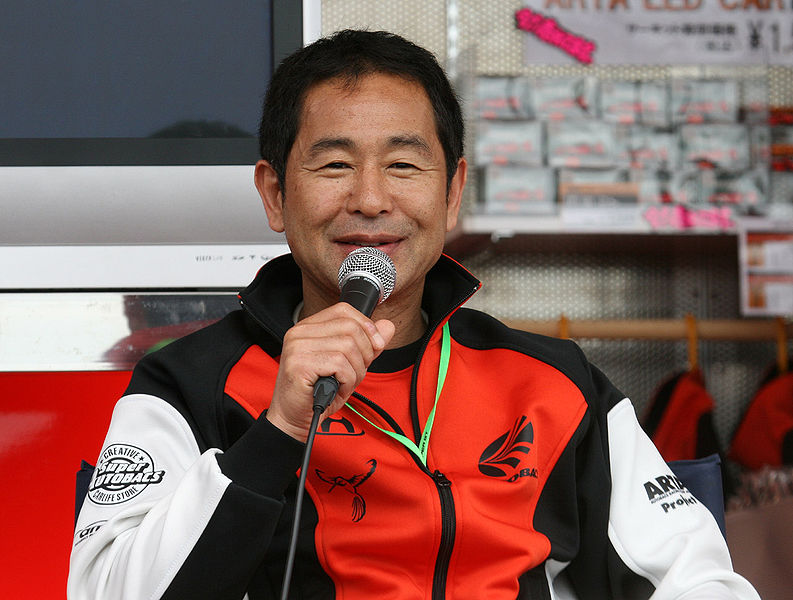
Keiichi Tsuchiya (土屋 圭市 Tsuchiya Keiichi?, born January 30, 1956) is a professional race car driver. He is also known as the Drift King(ドリキン Dorikin?) for his nontraditional use of drifting in non-drifting racing events and his role in popularizing drifting as a motorsport. He is also known for touge (mountain pass) driving.
The car he drives, a Toyota AE86 Sprinter Trueno, has become one of the most popular sports cars; the car is also known as "Hachi-Roku" in Japan (hachi-roku meaning "eight six"); his car is also called "The Little Hachi that could." A video known as Pluspy documents Tsuchiya's touge driving with his AE86. He also is a consultant for one of the popular comic books and manga, Initial D, of which the main characterTakumi Fujiwara is a character which describes him.File:Keiichi Tsuchiya 2008 Super GT.jpg

AE86 Specs

CarToyota Sprinter Trueno GT-V AE86 Super Street Version
Year1986
Body ColorSuper White II (Body) and TRD 3000GT Supra Gray (Engine Bay)
Underbody and EngineTec-Art's Full Complete Engine Blacktop 20v 7A-GE (7A Bottom, 5-Valve 4AG Head), Tec-Art and Tomei Pon-Cam (264/264 IN/EX 9mm Lift), TEC ART Type R Dual-Type Radiator, TEC ART Oil Cooler with Fan, Impulse 5 Valve Sink Kit, Nismo and TRD Metal Con Rods, Carbon Fiber Clutch for TEC ART 7AG, K1 Planning and Fujitsubo Twin Tip Exhaust Type N1, AE111 Genuine Catalyser, TEC Art Modified 3.5th TRD Crossed 5 w/ 4.778 (5.125 for Touge), TRD Short-Shifter Kit, TRD 2-way LSD, Tec-Art Header, & MOTEC ECU (TEC-ART SETTING)
Custom PartsTRD FRP Hatch with integrated TRD N2 Spoiler (1-piece), GT-APEX Headlamp Adjuster, No Power Steering or Air Conditioning, GT-V/Power Steering knuckles, GT-APEX Tilt Steering column, GT-APEX Dash and Power Mirrors, GT-Apex Windshield Adjuster, TRD Leather-wrapped Shift Knob, Non-Amber Clear Front Signal Lights, Zenki Front Lip with Special Bumper Lip Bracket, TRD Reclining Sports Bucket Seats, Sabelt Harness, Defi Gauges, TRD Carbon Fiber Hood, Raybrig Multi Reflector Light Kit, Nardi TRD 3 Spoke Steering Wheel, Shitsua Gas Lid, Autobacs ARTA Karo Floor Mats, TEC-ART Suspension Kit, Revolver AE86 Traction Bracket, Front MZ20 Brakes, Tec-Arts Rear Brake Kit.
Tire and Rim SizeFront and Rear 195/50R15 GoodYear RS Sport with Modex Dori Dori Mesh wheels(7j/off-2/15inches)