

R33

The R33 Skyline was introduced in August 1993. Slightly heavier than the R32, it is available in coupe and sedan bodystyles. All models now used a 6-cylinder engine. Nissan took the unusual step of down-grading the GTS model to have only the RB20E, while the twin-cam of the R32 GTS was discontinued along with the 2.0 L turbo RB20DET.
Some models came equipped with a new version of the HICAS 4-wheel steering system called Super HICAS. This computer controlled system was first used on the R32 GT-R. Super HICAS used electric actuators to steer the rear, as opposed to the hydraulic HICAS. This generation was no longer considered a "compact" under Japanese legislation that determined the amount of tax liability based on exterior dimensions.
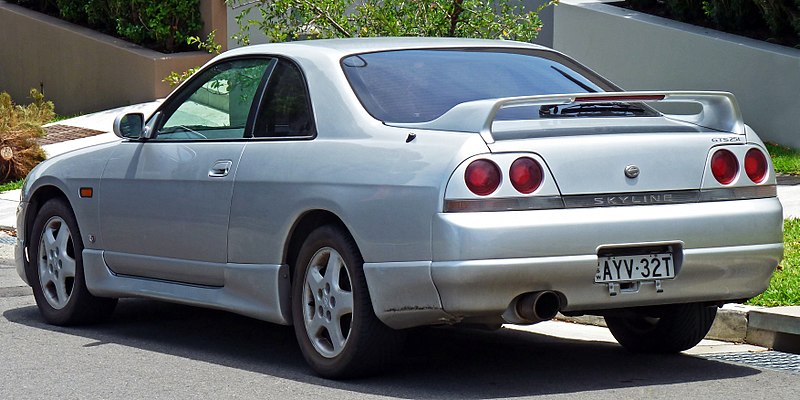
As an option, an active limited slip differential was available instead of the standard viscous LSD. This new unit locked the rear differential if it detected that traction was lost by one of the wheels. A light on the dash also lit up if the LSD engaged. Active LSD came standard on all V-Spec R33 GT-R Skylines and was also available on some ECR33 GTS-25t models; these can be identified by the A-LSD and SLIP lights on the tachometer.
The RB25DE and RB25DET engines also became equipped with NVCS (variable inlet cam phasing). NVCS equipped RB's have a bulge on the front of the cam cover. To celebrate their 40th anniversary, Nissan introduced a very rare 4-door GT-R. Two versions of the 4-door GT-R were available from Nissan's subsidiaries: the first was produced by Autech, and the second was a joint Autech/Nismo project.
A Nissan Laurel C34 based wagon was released in September 1996, called the Stagea. It is widely regarded as a compatriot of the Skyline, rather than the Laurel it was based on, owing to drivetrain configurations—Commonly AWD using ATTESA ET-S. A common modification on the Stagea is to fit it with an R34 skyline front, in effect making an R34-lookalike wagon. A manual transmission was only available on the RS-Four and RS-Four V models. There was also an Autech tuned Stagea, the 260RS; released with full GT-R running gear, including an RB26DETT engine and manual transmission, a unique body kit, 17" BBS style alloys, and GT-R instrumentation.
Models:
HR33 GTS – 2.0 L RB20E SOHC I6, 130 PS (96 kW, 172 N m)
ER33 GTS-25 – 2.5 L RB25DE DOHC I6, 190 PS (140 kW, 231 N m)
ENR33 GTS-4 – 2.5 L RB25DE DOHC I6, 190 PS (140 kW, 231 N m) 4WD
ECR33 GTS-25t (GTS-t) – 2.5 L RB25DET DOHC turbo I6, 250 PS (184 kW, 294 N m)
ECR33 P.Ride 280 Type MR – 2.8L RB28DET DOHC turbo I6, 300 PS

The R33 Skyline (Series 2) continued the concepts introduced in the R32. Driver and Passenger airbags became standard in 1996. As a result, pre-1996 models are barred from being imported into various countries for consumer road use as they do not meet the frontal impact standards. (However, in the U.S., there are Federal Laws regarding safety and emissions that require certain documents to be obtained, certain criteria to be met and adhered to, or 25 years to pass, before the sale of this vehicle becomes legal.) For the RB25DET engine the ignition system was also changed, with the ignition module no longer located on the cam covers and was instead replaced by smart ignition coils (Ignitor built into coil) and ECU. The RB25DET (turbo) was also given a Ceramic compressor wheel. Throughout the time the R33 was produced there were quite a number of different styled lights and bodykits fitted, the actual body/chassis underwent no changes. Among the cosmetic changes in the series 2 were, the headlights which tapered down more towards the grill and were fitted with improved reflectors, the grill (which was longer on the Series 1), the bonnet which had a re-shaped leading edge to fit the new lights and front bumper changing shape in the smallest amount to match the lower edge of the new headlights. Later models of the Series 2 also had the option of having an Active-LSD fitted. The R33 ceased production in February 1998 with the 40th Anniversary R33.
GT-R

The BCNR33 GT-R version also had the same RB26DETT engine that the BNR32 was equipped with, although torque had been improved, due to changes in the turbo compressor aerodynamics, turbo dump pipe, and intercooler. The turbo core changed from a sleeve bearing to a ball bearing, but the turbine itself remained ceramic, except on N1 turbos (steel turbine, sleeve bearing). From the R33 onward, all GT-Rs received Brembo brakes.[35] In 1995 the GT-R received an improved version of the RB26DETT, the ATTESA-ETS four-wheel-drive system, and Super HICAS 4-wheel steering.
A limited edition model was created in 1996, called the NISMO 400R, that produced 400 hp (298 kW) from a road-tuned version of Nissan's Le Mans engine. A stronger six-speed Getrag gearbox was used.
An R33 GT-R driven by Dirk Schoysman lapped the Nordschleife in less than 8 minutes. Though it was often said to be the first production car to break 8 minutes, the limited run Jaguar XJ220 had already achieved a 7'46" lap. Other manufacturers had caught up since the R32 was released, and the R33 never dominated motorsport to the extent of the R32.
Models:
GT-R – 2.6 L RB26DETT DOHC twin-turbo I6, 305 PS (224 kW, 375 N m) (advertised as 280 PS) 4WD
GT-R LM – 2.6 L RB26DETT DOHC twin-turbo I6, 305 PS (224 kW) FR
NISMO 400R – 2.8 L RBX-GT2 DOHC twin-turbo I6, 400 PS (294 kW, 478 N m) 4WD
4Dr.GT-R Autech Version – 2.6 L RB26DETT DOHC twin-turbo I6, 305 PS (224 kW, 375 N m) (advertised as 280 PS) 4WD - only 447 made

